





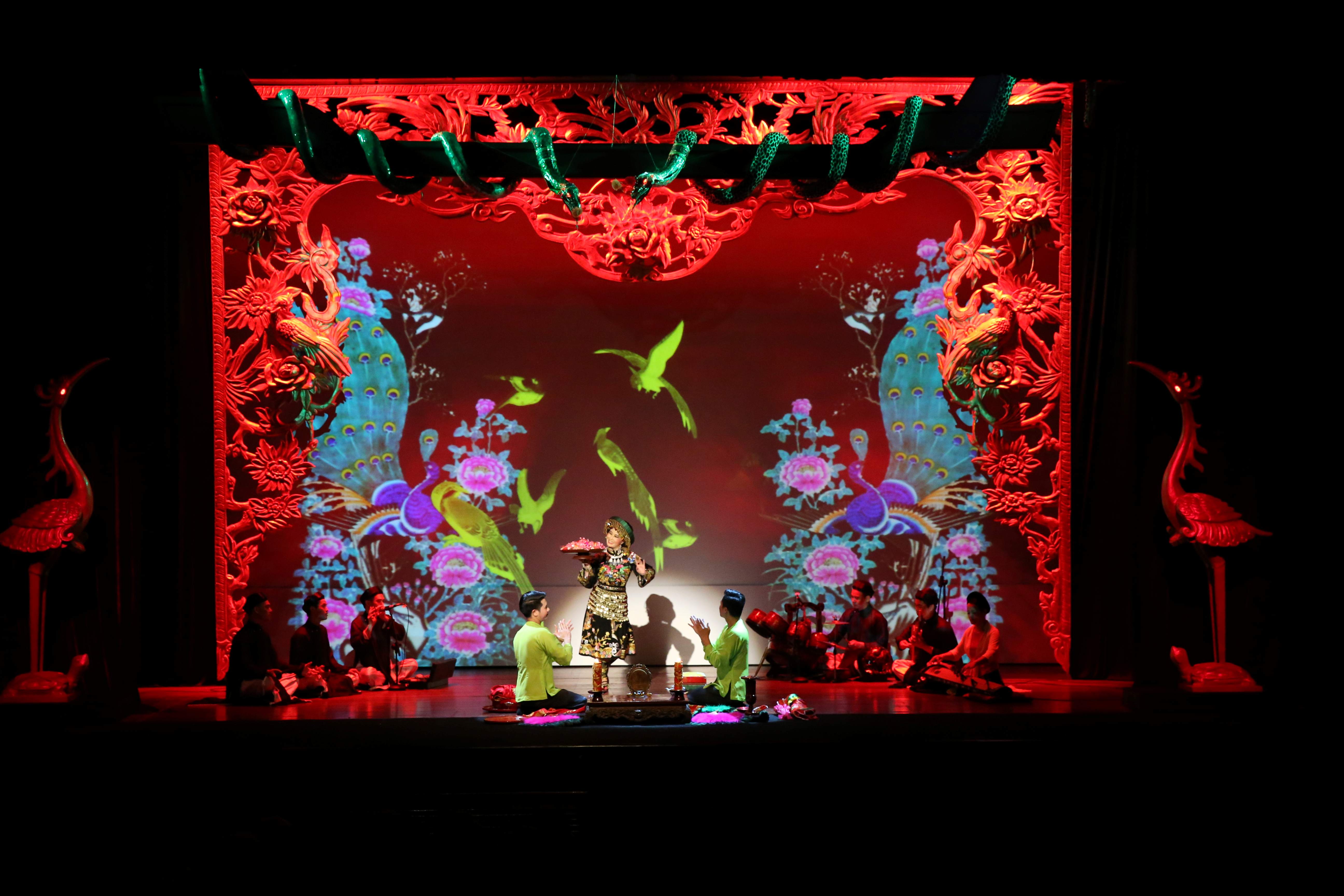
Director Viet Tu and his team spent three years researching, exploring, and directly experiencing the Mother Goddess worship rituals. They met with long-time practitioners, mediums, and folk artisans to find ways to preserve the original, delicate, and artistic values of the Len Dong ritual, while transforming this heritage into a performance capable of engaging modern audiences.
---
Timeline Tu Phu was created at a time when the practice of Mother Goddess worship was still viewed with conflicting perspectives regarding religion versus superstition. Consequently, bringing Len Dong to the stage posed a unique challenge: how to create an artistically compelling work without distorting the inherent beauty and historical significance of the ritual. True pioneering lies not in breaking with tradition, but in understanding it deeply enough to curate, select, and restructure its values—balancing the authenticity of a spiritual ritual with the necessary appeal of an entertainment piece, all while respecting sacred boundaries.
Tu Phu is structured as a 45-minute performance featuring three ritual segments (gia dong): Chau De Nhi, Ong Hoang Muoi, and Co Doi Thuong Ngan. Each segment carries its own distinct nuance, from the magnificent, solemn beauty of Chau De Nhi and the romantic aura of Ong Hoang Muoi to the vibrant, festive atmosphere of Co Doi Thuong Ngan.
---
The uniqueness of Tu Phu lies in the meticulous detail of its staging. The costume-changing sequence in the first act alone required months of practice. The two ritual assistants, who are typically not the focus of the ceremony, were integrated into the stage structure with movements precise to every beat. Every gesture, every lift, and every change of attire was calculated and rehearsed repeatedly to ensure the solemnity, rhythm, and true spirit of the ritual were maintained.
---
The visual language of the show was also developed directly from folk cultural materials. Hang Trong worship paintings were sourced, collected, and scanned at high resolution before being animated in graphic software, all while preserving the original spirit and lines of the art form. The stage design utilizes large-scale composite "cua vong" (altar gate) structures, crafted with an electroplated finish, to create a sense of grandeur and visual impact.
---
Even the guest reception area was structured as part of the historical experience. Traditional votive paper offerings, such as horses and elephants, along with decorative structures, were crafted by multi-generational artisans using authentic materials and traditional folk methods, resulting in a magnificent installation.
---
The costumes worn by the mediums and performers are intricately hand-embroidered, rivaling pieces found in fashion museums, while the sound, lighting, and even scents are carefully curated to create a multisensory experience rather than just a heritage performance.
---
The fusion of ritual authenticity and contemporary theatrical language defines the spirit of “Modern Traditional” that director Viet Tu and his team are committed to: using modern perspectives to highlight traditional values rather than turning tradition into a mere illustration or nostalgic relic. Consequently, the stage does not attempt to replace the temple space but instead creates a structure subtle enough for the inherent values of the Mother Goddess religion to be seen, heard, and felt in a new context.
---
Since its debut, Tu Phu has garnered significant attention from the cultural and artistic community, ambassadors, diplomats, and international travelers. Professor Ngo Duc Thinh, known as the living dictionary of Vietnamese Mother Goddess worship, attended and fully endorsed the program. Ambassador Pham Sanh Chau, former Special Envoy of the Prime Minister of Vietnam on UNESCO affairs—often called the champion of Vietnam's intangible cultural heritage—along with ambassadors, diplomats, and cultural attachés from countries such as the UK, France, Italy, Poland, Argentina, and Haiti, have also attended the performance. World-renowned fashion designer Kenzo also personally attended a show in Hanoi.
---
The show has also been featured in international cultural exchange activities, including a performance of the Co Doi Thuong Ngan excerpt in Tanzania before the President and Deputy Prime Minister, as well as at the 2016 World Travel Market in London. These activities have helped Tu Phu become a vehicle and a work of art that introduces Vietnamese culture through a language that international audiences can directly experience through visuals, music, and performance art.
---
Notably, in 2016, Practices related to the Viet beliefs in the Mother Goddesses of Three Realms were recognized as a UNESCO Representative Intangible Cultural Heritage of Humanity. Tu Phu contributed to bringing the values of this belief system closer to domestic and international audiences during the time the heritage dossier was being widely introduced and recognized.
With over 400 performances, Tu Phu has been consistently voted by TripAdvisor as one of the must-see performance experiences in Hanoi for many consecutive years. This demonstrates that a product rooted in indigenous culture can successfully become an artistic experience for international audiences when there is serious investment in research, performance quality, and storytelling.
---
For Dream Studio, Tu Phu is more than just a performance. It is a significant experiment in the potential to transform cultural heritage into a contemporary artistic product for the cultural and tourism industries without compromising its original values.
Tu Phu also laid the foundation for Dream Studio's future cultural industry projects, while opening up an approach that Dream Studio remains committed to: not just recreating heritage, but redefining it through the language of our time.
